Drupal CMS receives headless starters and why that's relevant if you are evaluating Storyblok!
Three releases, eighteen months, one converged story. Drupal CMS 1.0 turned the platform into an installable product. Drupal CMS 2.0, shipping Canvas, gave content teams real in-place editing. With the release of our lupus-decoupled starter package, we wired both to a ready-to-use Nuxt frontend. Here's how the pieces landed.
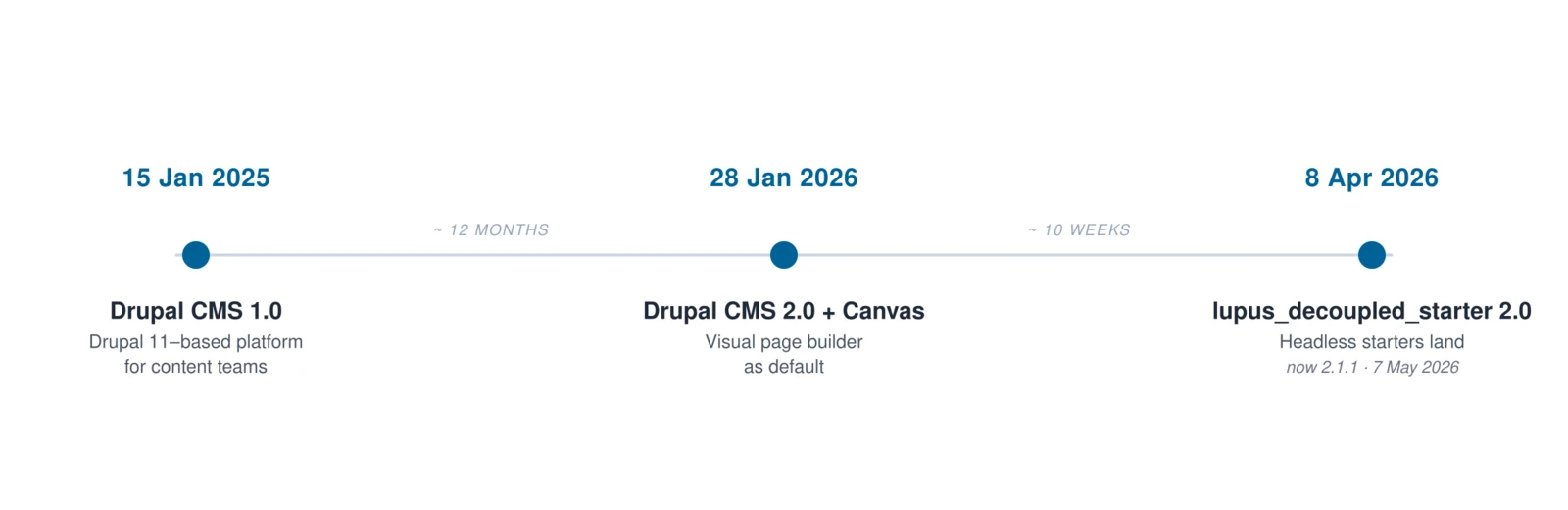
Sources: Drupal CMS 1.0 release · Drupal CMS 2.0 release · Drupal Canvas · lupus_decoupled_starter · drunomics/lupus-decoupled-nuxt-starter. Drupal side is covered by the Drupal Security Team; both starters are MIT/GPL-licensed.
You can drag components onto a page, edit in place, and undo changes. No jumping between forms and preview screens.
Net effect: one install on the Drupal side, one on the Nuxt side, and a content team is dragging Canvas components onto a page that renders through a Nuxt frontend. The historical Drupal objection — "the API is great, but the in-product editor experience is not" — is the one that Drupal CMS 2 + Canvas + the lupus-decoupled-starter systematically closes.
How this stacks up against Storyblok
What follows is a brief overview, not a full matrix. A more detailed comparison including additional CMS systems will follow in the coming weeks.
Drupal + lupus-decoupled-* starters |
Storyblok | |
| Visual page builder | Canvas in Drupal admin UI → renders via the Nuxt frontend | Visual editor, headless-native |
| Architecture mode | Hybrid: traditional / decoupled / headless (selected on a per project basis) | Headless-only by design |
| Built-in form builder | Via the Webform module | None built in |
| Contrib / extensibility | 55,000+ Drupal contrib modules, no vendor lock-in | Curated (proprietary) plugin ecosystem, narrower |
| Content portability | Standard OSS data formats (JSON, XML, YAML, CSV, etc.); export-friendly | Proprietary content schema based on JSON |
| EU data sovereignty | Self-host anywhere, or run on mossbo (ISO/IEC 27001 EU, AI inferences EU-only) | Austrian-rooted, multi-region cloud |
Storyblok's narrative of a typical team searching for that polished content API that can quickly be production-ready with a visual editor, is appealing. If that's the entire requirement, Storyblok remains a reasonable pick. Where Drupal pulls ahead is the depth behind the content layer, including structured-content primitives, a contribution module ecosystem that covers cases Storyblok plugins do not (e.g. Drupal's form API), the option to evolve into hybrid or traditional rendering later without changing platforms, and content that stays in standard formats rather than forced to use a vendor's schema.
Hosting & cost
Storyblok is a single SaaS product: Storyblok hosts the CMS, you pay a subscription. Pricing scales with seats, traffic, and feature tier — workflows and advanced roles are gated to the enterprise plan.
Drupal + the lupus-decoupled-* starters carry no hosting in the package. You pick the deployment shape:
- Self-host — zero license cost (GPL on the Drupal side, MIT on the Nuxt side). You pay for servers, ops, and patching cycles.
- Generalist managed Drupal hoster — Amazee.io / Lagoon, Platform.sh, Acquia, Pantheon, and similar. Infrastructure and patching handled; you still own configuration and code releases.
- Fully-managed Drupal SaaS — drunomics' mossbo is the closest like-for-like to Storyblok's posture: transparent monthly pricing (Cloud Lite €249, Cloud Pro €499, Enterprise custom), ISO/IEC 27001 EU hosting, AI inferences EU-only, security and major-version upgrades in the background, no per-seat fees, no feature gating by tier.
The honest trade-off: Storyblok gives you one pricing dial and one provider to call. The Drupal + Lupus path gives you platform freedom — but you (or your hosting partner) own the choice of where the site runs and how it stays patched.
What ships
Two repositories working hand-in-hand:
| Repo | Role | License |
| lupus_decoupled_starter | Drupal CMS 2 site template (recipe) bundling the Lupus Decoupled distribution + Canvas. Installed like any Drupal CMS template. | GPL, covered by the Drupal Security Team |
| lupus-decoupled-nuxt-starter | Nuxt 3 starter built on nuxtjs-drupal-ce. Skeleton Vue components under components/Canvas/ (heroes, cards, layout primitives, rich text). HTML-snapshot tests. Component-index file that Drupal reads on the Canvas side. |
MIT |
The two talk to each other through nuxtjs-drupal-ce. Drupal renders its custom-elements JSON; Nuxt picks up the components by name from the component-index. Decoupling without losing the editor experience.
The Nuxt-side components are deliberately skeleton — they demonstrate the contract; the design is yours to write. A frontend starter shouldn't lock you into someone else's design system.
Try it for yourself
The website documents two simple preview options:
Why we built it
drunomics has been shipping decoupled-Drupal + Nuxt for over a decade. The lupus-decoupled.org distribution is the upstream upon which all is built. The starter is the path we wished had existed when we onboarded teams in 2022 and 2023: a single repo to clone, the same wiring we use ourselves, no opinionated theme to fight, and a clear handshake with Canvas. It's also our answer to a question we keep getting from agencies and procurement teams."What do we hand a customer looking at headless options?" In 2026 that answer is simple: clone this, and you are running a Drupal CMS site with a Nuxt frontend before lunch, with the full Drupal toolkit available if your requirements grow.
Where to start
- The overview: lupus-decoupled.org
- Nuxt side:
drunomics/lupus-decoupled-nuxt-starter(start here; the README links to a Codespace). - Drupal:
drupal.org/project/lupus_decoupled_starter. - Issues, PRs, ⭐ — both repos are open source. The Nuxt-side starter is the right place to file a Canvas-decoupled issue.
Clone it, try it, let us know what you think of it.